
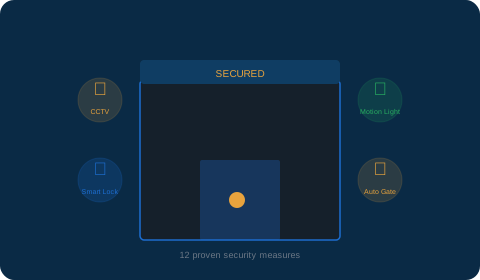
Most residential burglaries are not carefully planned crimes — they're opportunistic decisions made in seconds by someone walking past a property that looks easy. Research consistently shows that burglars choose targets based on perceived risk: how easily can they enter, and how likely are they to be seen? Making your property look like a higher-risk choice is what these 12 steps do.
Step 1: Install visible CCTV cameras at every entry point
Visible security cameras are the single most effective deterrent against opportunistic break-ins. Cameras at the main gate and front entrance should be positioned so they're clearly visible from the street — you want potential intruders to see them before deciding whether to approach.
Coverage priorities: main vehicle gate, front pedestrian entrance, rear access, driveway and any side passage that provides access to the back of the property. For most homes, 4–6 cameras cover these points without gaps. See our detailed guide on how many cameras you actually need for a property-by-property breakdown.
Cameras should include night vision — most break-ins attempt low-visibility periods, and a camera that only records clearly in daylight is covering the wrong hours. For best results, cameras with colour night vision capture clothing colours and facial detail even in darkness, making footage significantly more useful for identification. See our guide on how to choose an outdoor security camera.
Step 2: Add motion-activated exterior lighting
Darkness is a burglar's tool. A property with no exterior lighting gives an intruder the ability to work unseen at the front door, gate, or around the perimeter. Motion-activated lights immediately flood the area with light the moment someone approaches, making them visible to you, your neighbors, and to the camera at that location.
Key locations for motion-activated lights: above the main gate, above the front door, beside any rear access, and covering the driveway. Lights positioned to illuminate toward a camera (rather than at the camera) improve night footage quality significantly.
Step 3: Upgrade your door locks — the front door matters most
34% of break-ins use the front door. A surprising number of those involve standard single-point locks that can be forced quickly. Upgrade to:
- Multi-point locking — locks at multiple points along the door frame rather than a single bolt, making forced entry significantly harder
- Anti-snap lock cylinders — specifically designed to resist "lock snapping," a common forced-entry technique on standard Euro cylinders
- Door chain or bar — allows you to partially open the door to speak with someone without exposing the full entrance
Step 4: Replace physical keys with a smart lock
Physical keys can be lost, copied or handed over by a family member without your knowledge. A smart lock with PIN, fingerprint or app access eliminates the lost-key problem entirely and adds an access log — you can see exactly who entered and when, and revoke access for any specific code instantly.
Smart locks do not change the physical security of your door, but they address the key management problem, which is frequently how unauthorized entry happens in residential settings.
Step 5: Automate and secure your vehicle gate
An open or manually operated gate gives anyone who approaches your property easy vehicle access. An automatic gate with remote or app control keeps the entrance closed at all times except when you actively open it, and creates a clear perimeter that requires deliberate effort to cross.
Step 6: Install a video intercom at the gate
A video intercom lets you see and speak with anyone at your gate without opening it — even when you're not home, via the mobile app. This prevents the common approach of knocking to check whether anyone is home before deciding to target a property. A visible intercom camera also acts as an additional deterrent at the gate level.
Step 7: Secure first-floor windows
23% of break-ins use windows. First-floor windows that face away from the street are the most common targets. Window security measures include:
- Window locks — particularly on side and rear windows not visible from the street
- Window sensors — these trigger an alert when a window is opened unexpectedly, useful when integrated into a wider alarm or smart home system
- Security glazing film — makes glass significantly harder to break through quickly
Step 8: Use smart lighting timers to simulate occupancy
A home that looks empty for several hours is a more comfortable target than one that shows signs of activity. Smart bulbs or plug-in timers set to turn different lights on and off at varied intervals throughout the evening simulate the random pattern of someone actually moving around a home.
Vary the schedule — the same lights turning on at the same time every day are obviously automated. Random variations across different rooms are much more convincing.
Step 9: Don't neglect the garage
9% of break-ins use the garage, and many garages provide internal access to the house with a weaker door than the main entrance. Garage security measures:
- A motorized garage door with remote or app control ensures it's always fully closed
- The door between garage and house should be as secure as an external door — solid core with a deadbolt
- A camera inside the garage covering the internal door adds a layer of monitoring at this often-overlooked entry point
Step 10: Build these daily habits
Hardware is only effective when combined with consistent habits. The most common ways homes are targeted despite having security measures:
- Gate or garage left open while the owner is at home, providing free access to the property
- Valuable items (laptops, bags, cables) visible through a car window in the driveway
- Social media posts announcing vacation dates and duration
- Packages left visibly at the door for extended periods, signaling no one is home
Step 11: Consider a monitored alarm for high-value properties
A monitored alarm adds a human response layer: when triggered, a monitoring center alerts you and, if you're unreachable, contacts local authorities. The visible alarm siren box on an exterior wall is also a deterrent — most opportunistic intruders abort immediately when an alarm sounds.
For properties with high-value contents or frequent extended absences, the ongoing monitoring cost is typically worth the added protection and peace of mind.
Step 12: Know your neighbours
Active neighborhood awareness is one of the most effective deterrents that costs nothing. Burglars consistently rate occupied, alert neighborhoods as high-risk. Having a neighbor who knows your normal schedule, notices unfamiliar vehicles and has your contact details adds a human monitoring layer that no camera fully replicates.
Where to start if you're doing this in stages
Gates and main entrance first
Camera + intercom + smart lock at the main entry point address the majority of break-in risk immediately.
Add motion lighting and rear coverage
Side and rear cameras with motion lights address the second most common entry points.
Add window sensors and internal monitoring
For complete coverage once perimeter security is established.
If you're in Abu Dhabi and want a professional recommendation for your specific property, our engineers provide a free site assessment and fixed-price installation quote.
🛡 Free Scam Protection Guide
How scammers steal your money, fake products and card details — free PDF, no signup needed.
Download Free Guide (PDF)Frequently asked questions
Visible CCTV cameras at entry points, motion-activated exterior lighting, and signs of regular occupancy are consistently the strongest deterrents. Burglars choose targets based on perceived risk of being seen — these three factors increase that risk most visibly.
Yes. Visible cameras at entrances are a proven deterrent. They also provide evidence if an attempt does occur. Cameras with colour night vision are significantly more useful for identification than standard IR cameras.
Most residential break-ins happen during daylight hours — between 10am and 3pm when occupants are typically at work or school, not at night as commonly assumed.
Most homes need 4–8 cameras to cover all entry points. See our complete guide on how many cameras you need for a detailed breakdown by property size.
Front door (34%), first-floor windows (23%), back door (22%) and garage door (9%). Securing these four areas addresses the vast majority of break-in risk.
Comparable in physical security, but adds keyless entry (no lost or copied keys), remote locking and access logging. The door and frame quality matters more than the lock type.
Yes significantly. Motion-activated exterior lights make intruders immediately visible. Interior lights on random timers simulate occupancy. Darkness gives intruders cover — light removes it.
For high-value properties or frequent travel, yes. A monitored alarm adds a response layer and the visible siren box is a strong deterrent. For lower-risk properties, cameras and good locks address most of the risk at lower cost.
Signs without cameras provide minimal deterrence — experienced burglars often check whether cameras are actually present. Real cameras are significantly more effective and provide evidence that signs can't.
Motion-activated exterior lighting, upgraded door locks, and knowing your neighbours cost very little and meaningfully reduce risk. A single camera at the main gate is the most cost-effective first hardware investment.
Questions & comments
Have a question? Leave a comment and we reply within one business day.
Never thought about daytime being when most break-ins happen. We leave the gate open during the day, stopping that immediately.
Exactly the most overlooked point — daytime access with gate open is the most common entry we see on footage reviews. Happy to recommend a gate motor and intercom solution for your property.