
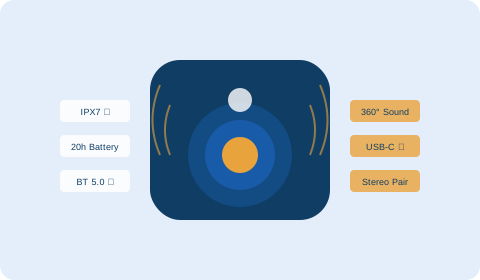
There are more Bluetooth speakers on the market in 2026 than any buyer could reasonably compare. From AED 50 clip-on units to AED 1,500 premium portable systems, the spec sheets all look similar — but the actual listening experience varies enormously. This guide identifies the features that genuinely predict how good a speaker will sound and last, and the ones that look impressive on the box but rarely matter in real life.
Whether you want a speaker for your beach bag, your kitchen counter, or your outdoor gatherings, the same seven features determine whether you'll be satisfied or disappointed six months after buying.
Feature 1: Sound quality — and why wattage doesn't tell you much
Sound quality is the most important feature in a speaker. It's also the hardest to judge from a spec sheet, because the number most prominently displayed — wattage — tells you about volume ceiling, not about how good it sounds.
What actually drives sound quality
Three things determine how good a Bluetooth speaker actually sounds:
- Driver size and quality — larger drivers move more air and reproduce bass frequencies more accurately. A speaker with a 50mm driver will generally produce better bass than one with a 40mm driver at the same wattage.
- Frequency response — ideally listed as a range in Hz (e.g. 60Hz–20kHz). Lower bass extension (50–80Hz range) means more audible bass. Flatter response across the range means more natural, uncolored sound.
- Driver configuration — some speakers add a passive radiator (a non-powered driver that resonates to reinforce bass), a tweeter for high frequencies, or multiple full-range drivers for better stereo separation. These improve sound more than higher wattage alone.
Feature 2: Battery life — and what the stated hours actually mean
Battery life is the second most critical feature for a portable speaker. But the hours printed on the box are always measured at 50–70% volume in ideal conditions. At 100% volume, expect roughly 40–60% of the stated battery life.
How long is enough?
| Use case | Minimum battery needed | What to look for |
|---|---|---|
| Desktop/indoor use | 8+ hours | Can often stay plugged in — battery matters less |
| Daily portable (gym, commute) | 12+ hours | Charge every night, comfortable daily range |
| Beach / full-day outdoor | 16+ hours | Can handle 8 hours at high volume |
| Multi-day camping / travel | 24+ hours | Reduces charging dependency significantly |
Also check: does the speaker support charging while playing? Some speakers pause playback when a power cable is connected, which is frustrating for desktop use.
Feature 3: Waterproof rating — non-negotiable for outdoor use
If a speaker will ever be near a pool, beach, shower, or outdoor gathering in rainy weather, the IP (Ingress Protection) rating is essential.
IP ratings explained for speakers
- IPX4 — protected against splashing from any direction. Handles light rain and sweaty gym bags. Not adequate for beach or poolside use.
- IPX5 — protected against low-pressure water jets. Handles rain, spray, and accidental splashes. Good for outdoor use away from water.
- IPX7 — can be submerged up to 1 metre for 30 minutes. The right choice for beach, pool and boat use.
- IP67 — adds dust-tight protection to IPX7 water resistance. Best overall protection for rough outdoor environments.
A speaker with no IP rating should not be taken near water at all, regardless of how it's marketed. In the UAE's humidity and outdoor environments, IPX5 minimum is strongly recommended for any speaker used outside your home.
Feature 4: Bluetooth version and connectivity options
Bluetooth 5.0 and above offer more stable connections, better range (up to 30–40m in open space), and faster pairing compared to older Bluetooth 4.x. In environments with many wireless devices — a crowded hotel lobby, a busy beach, a home with many smart devices — Bluetooth 5.0 drops out significantly less.
Multipoint connection — increasingly valuable
Multipoint connection allows a speaker to stay connected to two devices simultaneously — your phone and your laptop, for example — and switch audio between them without going through the pairing process each time. This feature was previously only on premium speakers but is increasingly common at mid-range prices. If you switch audio sources frequently, it's worth specifically looking for.
Other connectivity options worth checking
- 3.5mm aux input — useful as a backup when Bluetooth isn't available or when playing audio from a device without Bluetooth
- USB-C charging — significantly more convenient than older Micro-USB, and allows using the same cable as your phone
- NFC pairing — tap your phone to the speaker to pair instantly. Rarely faster than pressing a button, but convenient
Feature 5: Size and portability — match to your actual use case
Portable Bluetooth speakers span a huge range from clip-on units smaller than a tennis ball to large multi-driver systems the size of a shoebox. Size has a direct relationship with sound quality — larger enclosures produce better bass. The practical question is how you'll carry it.
Compact (under 500g)
- Fits in a bag easily, minimal space
- Limited bass due to small drivers
- Good for: gym, commute, desk use
Mid-size (500g–1.5kg)
- The sweet spot for most buyers
- Better bass, usually 16+ hour battery
- Good for: beach, gatherings, travel
Feature 6: Mono vs stereo sound
Most single portable speakers are mono — all sound comes from one point. True stereo requires two physically separated drivers, either in the same enclosure (separated by at least 15–20cm) or across two paired speakers.
Stereo separation matters most for listening position within 1–2 metres of the speaker. At a party with people scattered around, mono actually spreads sound more evenly. For close personal listening — at a desk, in a hotel room — stereo produces a significantly more immersive experience.
Some speakers offer both modes: a "360-degree" omni mode for groups and a stereo mode when two of the same unit are paired. This is worth paying slightly more for if you use the speaker in both settings.
Feature 7: EQ and app control — useful but not essential
Many speakers now come with companion apps offering EQ presets, firmware updates and occasionally party modes. EQ control is genuinely useful if you listen to a wide variety of music — boosting bass for hip-hop, flattening response for classical. But a speaker with a well-tuned default sound profile will satisfy most listeners without ever touching an app.
App requirements also have a downside: if the manufacturer discontinues the app, some features may stop working. Speakers with physical controls for core functions are more durable long-term.
Specs that are mostly marketing
- "Crystal clear HD sound" — not a measurable spec, entirely subjective
- Peak wattage vs RMS wattage — peak wattage is measured for a fraction of a second. RMS (continuous) wattage is the real figure. Many budget speakers advertise peak wattage, which overstates their actual output
- Built-in voice assistant buttons — they activate the assistant on your phone, which you could do yourself. Rarely useful on a speaker
- "Party mode" or LED light shows — lights consume battery, add weight, and have no effect on sound quality
Speaker buying checklist
Listen or read real reviews
Wattage and brand name don't predict sound quality. Read independent measurements or listen before buying.
Check battery life at high volume
Divide the stated battery by 1.6 to estimate real-world life at louder listening levels.
Match IP rating to use case
IPX4 for indoor, IPX5 for light outdoor, IPX7 for beach/pool.
Look for Bluetooth 5.0 if dropping out is a concern
Especially in busy environments or larger spaces.
Check USB-C charging
Same cable as your phone, faster charging, more future-proof.
Consider stereo vs mono
For close personal listening: stereo. For groups in open space: mono 360° is often better.
Common mistakes when buying a Bluetooth speaker
- Buying purely on wattage — a poorly tuned 30W speaker sounds worse than a well-tuned 10W speaker
- Ignoring IP rating for outdoor use — a single splashing incident can destroy an unprotected speaker
- Buying based on brand name alone — every brand has good and bad models, always check reviews for the specific model
- Not checking Bluetooth version when connection stability matters
- Buying the smallest/cheapest model expecting full bass — physics limits how much bass a small enclosure can produce regardless of price
🛡 Free Scam Protection Guide
How scammers steal your money, fake products and card details — free PDF, no signup needed.
Download Free Guide (PDF)Frequently asked questions
Sound quality and battery life are the two most important features. Sound quality can't be judged from specs alone — read independent reviews. Battery life at high volume is typically 40–60% of the stated figure.
IPX7 means the speaker can withstand immersion in up to 1 metre of water for 30 minutes. For beach and pool use, IPX7 is the minimum recommended rating.
No. Wattage indicates volume ceiling, not audio quality. A well-designed 10W speaker routinely sounds better than a poorly designed 30W speaker. Always prioritize independent reviews over wattage figures.
For daily portable use, 12–16 hours at moderate volume is a good baseline. For full-day outdoor use, 16–20 hours. Remember that battery life at 100% volume is typically 40–60% less than the advertised figure.
Bluetooth 5.0 offers better range and more stable connections in environments with many wireless devices. For everyday use, 4.2 performs fine, but 5.0 reduces dropouts in busy environments like offices or busy outdoor spaces.
Many speakers support stereo pairing or party modes — usually only between two units of the same model. Check the spec sheet for "TWS stereo pairing" or "Party mode" if this matters to you.
For solo listening at close range, stereo produces a richer experience. For groups in open space, a 360-degree mono speaker distributes sound more evenly. Some speakers offer both modes when paired.
Useful if you listen to very different genres, but a speaker with a well-tuned default sound satisfies most listeners without app control. Don't pay a premium for EQ if the default sound profile sounds good to you.
10–15 metres in open space with no obstacles for most speakers. Walls and interference reduce this. Bluetooth 5.0 speakers maintain reliable connection at longer range.
A passive radiator is a non-powered driver that vibrates to reinforce bass frequencies. Speakers with passive radiators typically produce better bass for their physical size compared to ports or vents.
Questions & comments
Have a question? Leave a comment and we reply within one business day.
Finally an explanation of what wattage actually means. I was about to buy a 40W speaker assuming it was better quality, not just louder. Changed my decision completely.
The IP rating section is what I needed. Taking to the beach and got IPX5 last time — fine for splashes but glad I know IPX7 is what to get next time for poolside.